
Invoice vs receipt
One asks for money, the other proves it arrived. When to send each, and what goes on them.

An invoice asks for payment; a receipt proves payment was made. You send an invoice after delivering goods or services, listing what is owed and when it is due. You give a receipt after the customer pays, confirming the amount, the date and how they paid. The same sale can produce both: first the invoice, then the receipt.
Side by side
| Invoice | Receipt | |
|---|---|---|
| Purpose | Request payment | Confirm payment |
| When | Before payment, after the work or sale | After payment |
| Shows | Amount due, due date, how to pay | Amount paid, date paid, payment method |
| Key number | Invoice number | Receipt number, often referencing the invoice |
| Typical use | Business clients, services, credit terms | Shops, cash and card sales, paid invoices |
| For the customer | A record of what they owe | Proof for expenses, returns and taxes |
What goes on an invoice
The word “Invoice”, a unique number, the issue date, your details and the client’s, the items with prices, tax, the total due, the due date and payment instructions. Our invoice checklist goes through each one.
What goes on a receipt
- The word “Receipt” and a receipt number.
- Your business name and contact details.
- The date of payment.
- What was paid for, or the invoice number it settles.
- The amount paid, the currency, and any tax included.
- The payment method: cash, card, bank transfer.
- The balance remaining, if it was a part payment.
Where estimates and bills fit
- Estimate or quote: proposes a price before work starts, so the client can agree. It asks for nothing yet. The hub guide on how to write an estimate shows how one turns into an invoice.
- Bill: to the payer, any request for payment is a bill. “Invoice” is the usual term between businesses; “bill” is common for utilities and restaurants.
- Pro forma invoice: a preliminary invoice sent before delivery, for example so a buyer can arrange payment or import paperwork. It is not a demand for payment in the usual sense.
- Credit note: cancels or reduces an invoice already sent, for example after a return or a correction.
The typical order
- Estimate: “This job will cost 1,200.”
- Invoice: “The job is done. Please pay 1,200 by 30 June.”
- Receipt: “Received 1,200 by bank transfer on 24 June. Thank you.”
For small, immediate sales, such as a shop, the invoice step is skipped and the receipt is the only document.
Can a paid invoice serve as a receipt?
A copy of the invoice marked Paid, with the date and method of payment, is often accepted as proof of payment by customers, but not everywhere and not for every purpose. If a customer asks for a receipt, send one. Tax rules on receipts vary by country; this is not tax advice.
Tools
- The free invoice generator makes invoices and estimates as PDFs in your browser, with nothing uploaded.
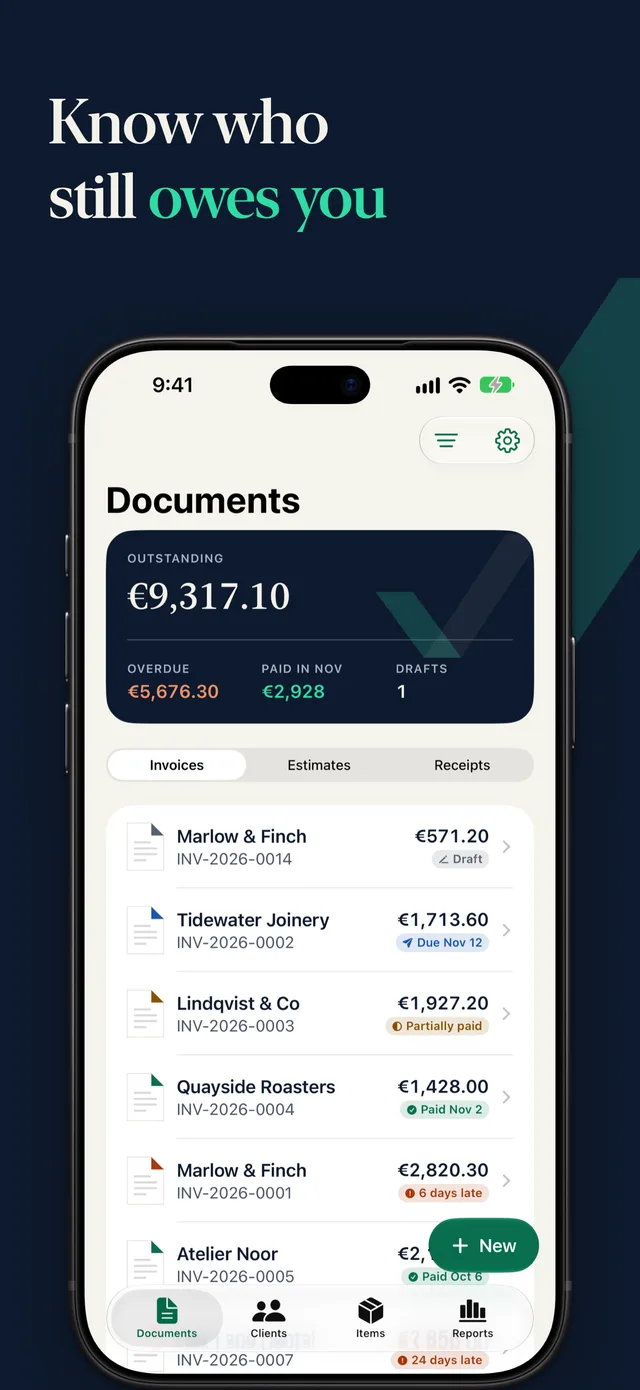
- Paidly for iPhone, iPad and Mac records full and part payments against each invoice and shows what is still outstanding, so you always know which invoices have been paid.
The invoice is the easy part
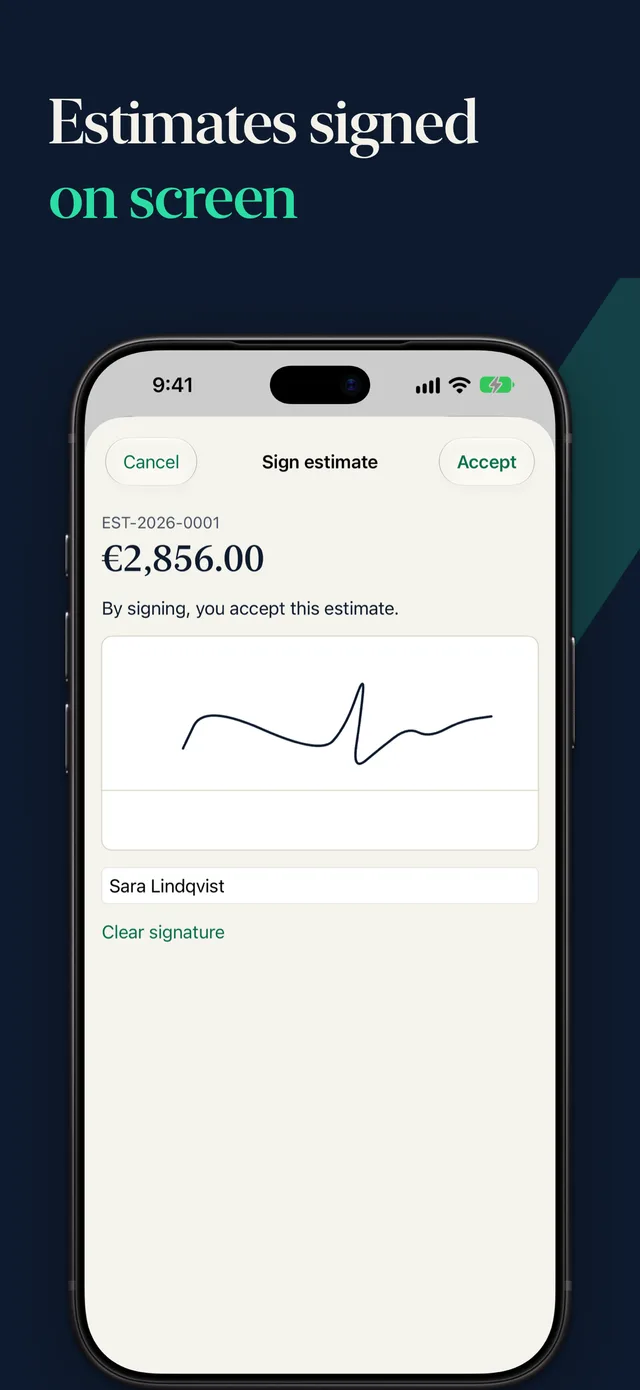
Paidly on iPhone, iPad and Mac keeps track of what comes after it.
- Clients
- Each client with their address, payment terms, currency and language, ready for the next invoice.
- Recurring invoices
- Repeat an invoice every week, month, quarter or year.
- Payments
- Record full and part payments. The first screen shows what is outstanding and what is overdue.
- Signed estimates
- The client signs the estimate on screen, and it turns into an invoice in one tap.
Free to start with unlimited drafts and three sent documents a month. Recurring invoices, reminders and signed estimates come with Paidly Pro.
Questions
What is the difference between an invoice and a receipt?
An invoice is a request for payment sent before the customer pays. A receipt is proof of payment given after they pay. An invoice shows an amount due; a receipt shows an amount paid.
Can an invoice be used as a receipt?
Not on its own. An invoice shows what is owed, not that it was paid. Marking a paid invoice as Paid, with the date and method, or issuing a separate receipt, records the payment.
Is a bill the same as an invoice?
Mostly. Both ask for payment. Invoice is the usual word between businesses; bill is common for utilities, restaurants and everyday services. To the person paying, an invoice is a bill.
Do I need to give a receipt after an invoice is paid?
It depends on your country and the customer. Many customers want one for their records, and some tax rules require it for certain sales. Sending one is good practice.
What comes first, an estimate, an invoice or a receipt?
An estimate, if the price is agreed before the work. Then an invoice when the work is done. Then a receipt once the invoice is paid.
More invoicing guides
- What to include on an invoice
- Net 30 and other payment terms, explained
- How to ask for payment politely
- How to invoice a deposit
- How to cancel or correct an invoice with a credit note
- How to invoice for hours worked
- How to bill clients on a recurring invoice
- How to make an invoice on iPhone
- How to write an estimate that turns into an invoice
Invoice templates by trade
Each one opens the generator filled with the lines that trade bills for.
Freelancer invoice template
A project fee, extra hours, payment terms.
Invoice $2,340.00
Cleaning invoice template
Monthly visits, a deep clean, supplies.
Invoice $785.00
Construction estimate template
Labor, materials, a validity date.
Estimate $5,220.00
Photography invoice template
Coverage, second shooter, album, package discount.
Invoice $3,825.00