
How to invoice a deposit
How much to ask for up front, what to write on the deposit invoice, and how to settle it on the final bill.

A deposit invoice asks for part of the agreed price before you start. It protects you from buying materials or turning down other work for a client who then disappears, and it tells you early that the client is serious. The invoice itself is short: it names the job, the estimate or contract it belongs to, the deposit amount and when it is due.
This guide covers how much to ask for, what to put on the invoice and how to settle the deposit on the final bill. It is practical advice, not tax or legal advice.
When a deposit makes sense
Ask for a deposit when you spend money or turn away work before the client pays anything:
- You buy materials for the job, such as tiles, timber, fabric or printing.
- You book a date that you cannot easily fill again, such as a wedding shoot or a week on a renovation.
- The job is long, so the full payment would arrive weeks or months after you start.
- The client is new and you have no history with them.
For a two-hour repair for a regular customer, a deposit adds friction for little gain. Send one invoice when you finish.
How much to ask for
There is no single rule. Common practice:
| Situation | Typical deposit |
|---|---|
| Design, writing and other freelance projects | 25 to 50 percent |
| Trades work with materials | Enough to cover the materials, often 30 to 50 percent |
| Event and photography bookings | A fixed booking fee, sometimes 50 percent |
| Custom or made-to-order goods | 50 percent or more |
Two limits are worth checking before you pick a number. Some places cap deposits for home improvement contracts, and some say whether a deposit is refundable if the client cancels. Put your cancellation terms in the estimate or contract so nobody argues about them later.
Agree it before you invoice it
A deposit invoice that arrives out of nowhere looks like a demand. Put the deposit in the estimate first:
- Write the estimate for the full job. If you need help, the hub has a guide on how to write an estimate.
- Add a line under the total such as “Deposit of 30% (USD 1,200) due on acceptance, balance due on completion”.
- Ask the client to accept the estimate in writing or by signature.
- Send the deposit invoice right after they accept.
What to put on a deposit invoice
A deposit invoice is an ordinary invoice with a clear purpose. It needs everything listed in what to include on an invoice, plus three details:
- A title or line that says what it is, such as “Deposit for kitchen renovation, estimate E-0217”.
- The reference to the estimate, quote or contract number, so the deposit can be matched later.
- The deposit amount, either as a fixed figure or as a percentage of the agreed total. Write both if it helps: “30% of USD 4,000 = USD 1,200”.
Use one line item for the deposit. Listing every task with partial prices makes the final invoice harder to reconcile.
Due date
A deposit is usually due on receipt or within a few days, because you will not start until it arrives. Say so plainly: “Due on receipt. Work is scheduled once the deposit is received.” See Net 30 and other payment terms for the other options.
Tax
In many VAT and GST systems, tax becomes due when you receive an advance payment, not when the job ends. That means the deposit invoice shows tax on the deposit amount, and the final invoice shows tax only on the balance. In the US, sales tax rules on deposits vary by state. If you are registered for a sales tax, VAT or GST, check how your country treats advance payments.
Settling the deposit on the final invoice
When the work is done, send a final invoice for the full job and subtract what has already been paid:
| Line | Amount |
|---|---|
| Kitchen renovation, as estimated | 4,000.00 |
| Extra outlet, agreed on site | 150.00 |
| Less deposit paid, invoice 1042 | -1,200.00 |
| Balance due | 2,950.00 |
Keep the deposit line visible. A final invoice that shows only the balance leaves the client wondering what the 2,950 is for, and leaves your bookkeeping without a link between the two invoices.
The free invoice generator accepts a negative price on a line, so you can add the “Less deposit paid” line and the total will come out as the balance.
Staged payments on longer jobs
For a project that runs for months, one deposit and one final bill can leave a long gap with no money coming in. Split the price into stages instead:
- Deposit on acceptance, for example 30 percent.
- A progress invoice at an agreed milestone, such as the end of the first fix or the first draft, for example 40 percent.
- A final invoice on completion for the rest.
Name each stage in the estimate, so each invoice simply points back to it. Number each invoice in the same sequence as your other invoices; a stage is not a reason to start a new series.
When the client pays only part of it
If a client sends less than the deposit, record what arrived and wait for the rest before you start. If they pay part of a later invoice, record the part payment, keep the invoice open and show the remaining balance on your reminder. The guide on how to ask for payment has wording for a polite follow-up.
Deposits in Paidly
Paidly for iPhone, iPad and Mac turns an accepted estimate into a deposit invoice for 30 percent of its total with one action, with the estimate number as the reference. Later the estimate converts into the full invoice, and part payments are recorded against it, so the list shows it as partially paid until the balance arrives. Deposit invoices and estimate conversion are part of Paidly Pro.
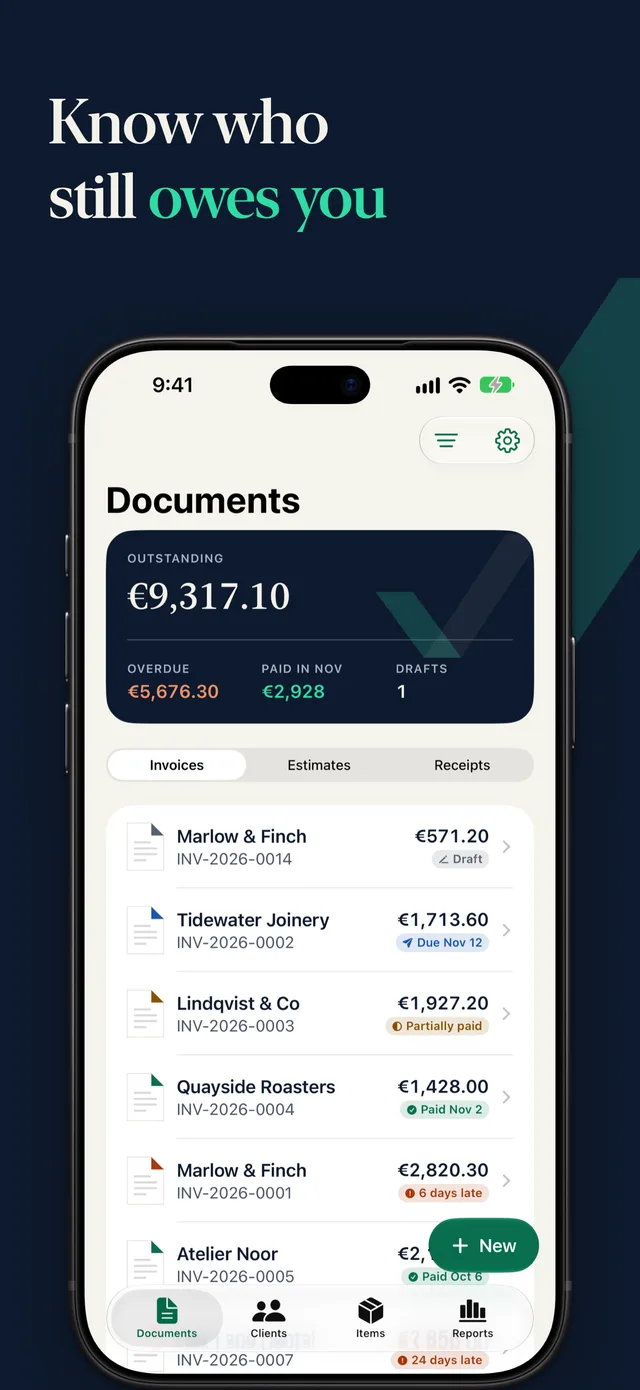
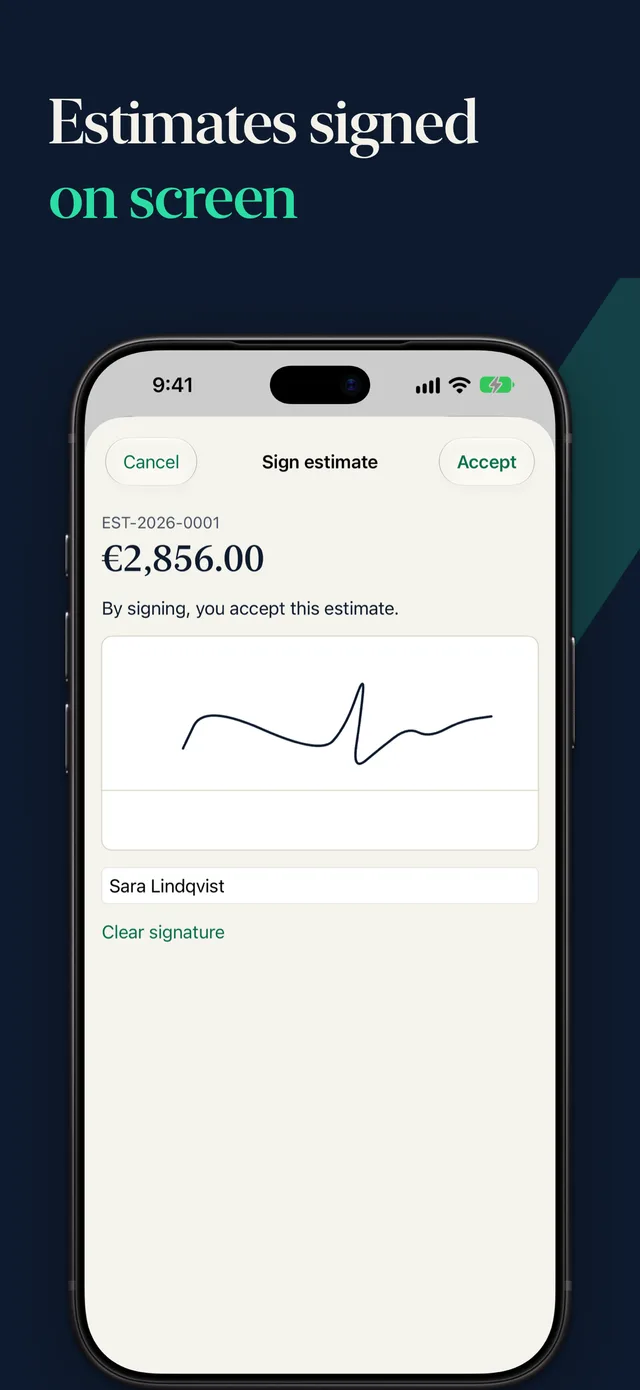
The invoice is the easy part
Paidly on iPhone, iPad and Mac keeps track of what comes after it.
- Clients
- Each client with their address, payment terms, currency and language, ready for the next invoice.
- Recurring invoices
- Repeat an invoice every week, month, quarter or year.
- Payments
- Record full and part payments. The first screen shows what is outstanding and what is overdue.
- Signed estimates
- The client signs the estimate on screen, and it turns into an invoice in one tap.
Free to start with unlimited drafts and three sent documents a month. Recurring invoices, reminders and signed estimates come with Paidly Pro.
Questions
What is a deposit invoice?
An invoice for part of the agreed price, sent before the work starts or the materials are bought. It refers to the estimate or contract it belongs to, and the final invoice later subtracts it.
How much deposit should I ask for?
Many trades and freelancers ask for 25 to 50 percent. Ask for enough to cover materials and the time you block out for the client. Some countries and states cap deposits for certain work, such as home improvement, so check local rules.
Do I charge tax on a deposit?
Often yes. In many VAT systems tax is due when the advance payment is received, so the deposit invoice shows tax on the deposit amount. Rules differ by country; ask your accountant if you are unsure.
Is a deposit the same as a retainer?
Not quite. A deposit is part payment of one specific job. A retainer is usually a recurring fee for ongoing availability or a block of work, billed every month or quarter.
How do I show the deposit on the final invoice?
List the full work as usual, then add a line such as Less deposit paid, invoice 1042, with the amount as a negative figure. The balance due is what is left.
More invoicing guides
- What to include on an invoice
- Invoice vs receipt
- Net 30 and other payment terms, explained
- How to ask for payment politely
- How to cancel or correct an invoice with a credit note
- How to invoice for hours worked
- How to bill clients on a recurring invoice
- How to make an invoice on iPhone
- How to write an estimate that turns into an invoice
Invoice templates by trade
Each one opens the generator filled with the lines that trade bills for.
Freelancer invoice template
A project fee, extra hours, payment terms.
Invoice $2,340.00
Cleaning invoice template
Monthly visits, a deep clean, supplies.
Invoice $785.00
Construction estimate template
Labor, materials, a validity date.
Estimate $5,220.00
Photography invoice template
Coverage, second shooter, album, package discount.
Invoice $3,825.00